


Completed Projects
Since 1972, the Society of Friends of Ephesos has been supporting a wide variety of projects at the excavation site: from the reconstruction of monuments to the installation of protective canopies and the digital visualisation of the ancient city.
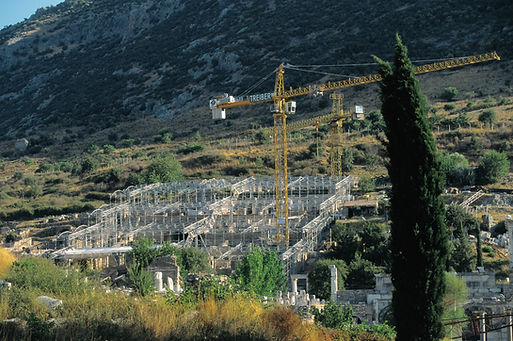
Protective roof of Terrace House 2
In addition to its undisputed scientific and cultural-historical relevance, Terrace House 2 also poses a major challenge in terms of conservation. While the paintings uncovered during the discovery of Terrace House 2 were removed and taken to the museum in Selçuk, the abundance of decorative surfaces meant that, right from the start of the excavation work in the 1970s and 1980s, it was decided to leave them in situ. Despite continuous protective measures, loss of substance was unavoidable due to climatic conditions. Thus, the need for a protective roof was recognised in the early years of the excavation. The declared goal was to create a museum at the ruins site, to exhibit the uncovered objects in their original context, and to be able to explain and present the archaeological findings directly on site. It took 38 years, many discussions and project designs before the protective structure, now known as ‘A Roof for Ephesos’, could be erected with the help of numerous major sponsors, including the Society of Friends of Ephesos, which took the initiative, and the monument could be presented to the public. A so-called specification sheet defined the requirements for the protective structure, which was to differ significantly from the ancient building elements of Terrace House 2 in terms of construction, colour and choice of materials, but was also to be less conspicuous than the ruins. Furthermore, protection against the elements, reversibility and dismantlability were essential requirements. Taking into account the mistakes of the past, great importance was attached to climatological findings. The roofing material was intended to form a breathable, UV-resistant and durable skin over the building that would allow natural ventilation. The result is a stainless steel construction that only interferes with the antique structure in a few places. The lamellar façade panels made of Lexan, a type of polycarbonate, allow for constant air exchange and are therefore crucial for maintaining a balanced climate inside the building. The roof surfaces were covered with a textile, glass fibre-reinforced membrane, whose Teflon coating was predicted to provide self-cleaning properties, high strength and a long service life. A conscious decision was made not to reconstruct ancient building elements, and the lighting and pathways do not correspond to Roman reality. Instead, a visitor guidance system was used to create illusionistic views and perspectives that allow a new and unexpected perception of what is on display. Terrace House 2 has been open to visitors since 2006 and attracts an average of around 160,000 visitors.


Re-erection of the Celsus Library
The Celsus Library was donated between 100 and 110 AD by Gaius Iulius Aquila for his father, Senator Tiberius Iulius Celsus Polemaeanus. The library is actually to be understood as a heroön, built over the burial chamber of the deceased Celsus Polemaeanus. A nine-step staircase leads to the vestibule, from which the three-storey library room could be accessed. Below this is the burial chamber with the sarcophagus. The scrolls were stored in cupboard-like niches, which could be reached via galleries on the upper floors. The library was destroyed in an earthquake around 270 AD. In late antiquity, the remains of its magnificent façade served as the back wall of a street fountain. Excavated as early as 1905/1906, the building was only rebuilt between 1970 and 1978 with the help of funding from Anton Kallinger-Prskawetz and the Society of Friends of Ephesos.


Re-erection of the Mazaeus-Mithridates Gate
Between 1978 and 1988, the Society of Friends of Ephesos provided significant support for the reconstruction of the Mazaeus-Mithridates Gate, also known as the South Gate. Originally, the gate, which stands at the edge of the commercial market of Ephesos and next to the Library of Celsus, was designed in the style of a triumphal arch. However, shortly after its construction, it was converted into the entrance gate to the Tetragonos Agora during its expansion under Emperor Augustus (27 BC – 14 AD). The inscription on the attic states that Mazaeus and Mithridates, freedmen of the imperial family, erected the gate in 3 BC in honour of Augustus, his wife Livia, his son-in-law Agrippa and his daughter Iulia. Many other inscriptions on the gate provide information about prices, construction measures and the city's grain supply.


Geophysical Studies
Geophysical studies have been significantly intensified in Ephesos in recent years. The aim is to use prospecting to complete the city map of Ephesos. Seismic and magnetic methods were used, as well as ground-penetrating radar, which proved to be particularly effective. Geophysics allows large areas to be investigated quickly and, above all, non-destructively. The measurement areas cover the entire city, the sanctuary of Artemis and the surrounding area. Since 2000, around 120 ha have been investigated using geomagnetics and 75 ha using ground-penetrating radar. The measurements in the necropoleis of Ephesos, where rows of graves are clearly visible, proved fruitful. The results in the harbour area are particularly spectacular, where a densely built-up quarter was discovered outside the city walls. But the measurements are also adding to our knowledge of Ephesos itself. The excavated buildings no longer stand in isolation, but can be embedded in their architectural environment. This is slowly creating an overall picture of an antique city.

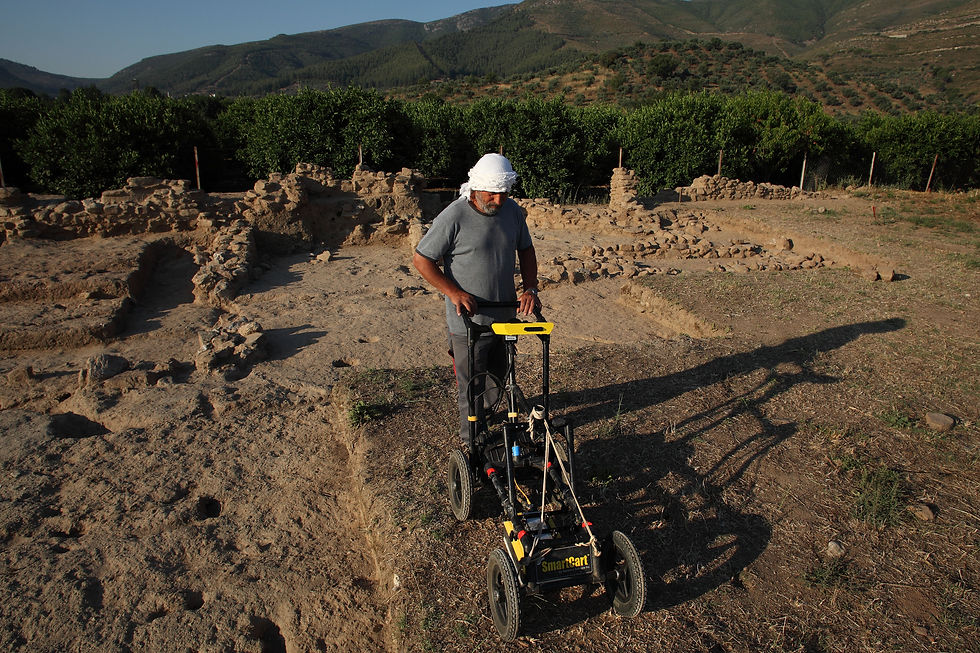

Geological survey
Geology is an important complementary science to archaeology, especially when it comes to the origin of raw materials and other materials. In addition, geomorphology influences human activity, especially in the establishment and development of settlements. In 2012, geological mapping and a raw materials survey conducted by the Montanuniversität Leoben under the direction of W. Prochaska and G. Rantitsch were completed at Bülbüldağ, the southern city mountain of Ephesos. This allowed all raw materials to be recorded and samples to be taken for further scientific analysis. Of particular interest, of course, are the building materials used in Ephesos itself. Another important aspect is hydrogeology, which provides crucial information about the city's water balance.


Theatre
The Great Theatre of Ephesos has been available for cultural events again since 2013. Numerous earthquakes and landslides over the last two millennia had caused the two side wings of the building in particular to become destabilized by numerous cracks and were generally in poor condition. In 2010, the Austrian Archaeological Institute therefore presented a three-stage plan for the fundamental consolidation (e.g., steel support structures for the entrance areas), adaptation, and reopening of the building. It included a minimum of conservation work, extensive safety measures for the building, and safety measures for visitors.


Late antique-medieval city quarter
Towards the end of the 4th/beginning of the 5th century AD, Ephesos re-established itself as a supraregional political and economic center. The growing Christian religion left its mark on the city. As part of a centrally controlled construction program, representative buildings of a secular and sacred nature were erected in the lower city of Ephesos. Thanks to support from the Society, the Ephesos Excavation was able to excavate part of a neighbourhood consisting of spacious private buildings by 2016. The excavated building complex was located south of St. Mary's Church and was built over the imperial “Verulanus Halls”. Prestigious residential areas were discovered, as well as parts of buildings where production and trade can be verified. They were used from late antiquity to the Middle Ages (4th/5th century – 12th century AD). Further analysis of the finds and findings is expected to provide far-reaching insights into the so-called Dark Ages of the late period of the city of Ephesos.


EPH.DIGITAL
In recent years, advances in methodology and the integration of a wide variety of disciplines into basic archaeological research, as well as technological progress, have led to an enormous increase in the amount of digital data (e.g. databases documenting archaeological structures and finds, 3D laser scans, survey data, material analyses). In addition, there is analogue data, such as handwritten excavation diaries, correspondence, plans and sketches, which are stored in the archives and collections of the Austrian Archaeological Institute and represent unique evidence of earlier excavation projects. Case study: Late Antiquity-Medieval City Quarter By the end of 2019, a comprehensive solution for the uniform and structured collection, processing and long-term archiving of data generated during the excavation of the Late Antiquity-Medieval city quarter south of the Church of St. Mary in Ephesos, or data still to be expected, will be developed. The aim is not only to ensure long-term archiving, but also to create a practical tool for individual users/editors to process the various types of data and optimise workflows. Existing solutions from related institutions should be taken into account in order to ideally enable data exchange with other projects. Another goal is to make the information available online to the scientific community and the interested public. The solution developed in the case study will subsequently be applied to the entire Austrian Archaeological Institute (OeAI). This project is part of the ‘Archaeological Information and Archiving System’ initiative at the Austrian Archaeological Institute.


Ephesos 4D - The virtual city
Archaeologists and building researchers are combining their most recent published research on the monuments and urban areas of Ephesos. These will form the basis for the digital visualisation which will then be created by the Austrian company 7reasons Medien GmbH, which specialises in the multimedia presentation of research results. Visualisations have always been part of the methodological repertoire of archaeologists and building researchers. Graphical reconstructions also have a long tradition at the Austrian Archaeological Institute, which is leading the excavations at Ephesos. They have been used both to depict buildings and to give impressions of the whole city. By the end of the 20th century, hand-drawn, detailed views and perspective drawings had been replaced by digitally modelled visualisations. The main priority for the »Ephesus 4D project« is the need for the virtual model to be scientifically accurate and long-lasting. The latest research results will be stored in the metadata for the models of individual monuments, so it will still be possible to review the underlying information in the future. The same is true of the various work stages involved in producing the visualisation. It will be important for scientists to be able to trace those as they continue to use and evaluate the virtual model. What’s more, because the research is ongoing, it must be ensured that the visualisation can be updated as new findings become available, with the previous versions being archived. This requires careful data management, which is being conducted in this project in compliance with international standards on the computer-based visualisation of cultural heritage. The virtual models of Ephesos in Imperial times and in Late Antiquity will bring a new dimension to the way the results of research into the history of the city are portrayed and presented, and they will have many different applications. For example, they could be used in exhibitions, documentary films and print media, or on websites or social media platforms. At the same time, the advanced methodology of the models opens up new options for future analysis in the fields of historical architecture and urban planning, using digital tools and simulations.


